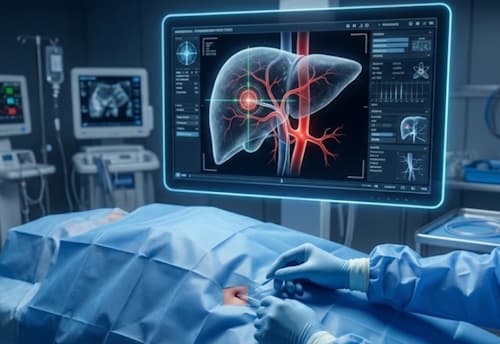
Transarterial Chemoembolization (TACE) is a standard treatment for primary liver tumors, particularly Hepatocellular Carcinoma (HCC). The method combines the delivery of chemotherapy directly to the tumor with the blockage of its blood supply to deprive cancer cells of oxygen and nutrients, thereby leading to tumor destruction.
The success of chemoembolization is based on the unique anatomy of the liver. The liver is an exceptional organ with a dual blood supply: the Portal Vein and the Hepatic Artery. While healthy liver tissue receives about 75% of its blood supply from the portal vein, cancerous liver tumors (such as HCC) are fed almost exclusively (over 90%) by the hepatic artery. This anatomical fact allows the interventional radiologist to deliver chemotherapy drugs and block the vessels leading to the tumor through the artery, with minimal impact on the surrounding healthy liver tissue, which continues to receive nourishment from the vein.
Before starting treatment, the patient undergoes a series of preliminary tests such as CT, MRI, or ultrasound to evaluate the size, location, and status of the tumor, as well as blood tests including liver function, coagulation, and blood counts to assess feasibility. On the day of the procedure, the patient receives premedication to reduce the chance of pain and discomfort following the procedure,
as well as antibiotics.
An interventional radiologist inserts a catheter through the femoral artery in the groin or the radial artery in the forearm and guides it through the arterial system until the catheter reaches the specific hepatic artery supplying the tumor. The procedure is performed under fluoroscopic imaging guidance to ensure maximum precision. Once the catheter is positioned in the artery leading to the tumor, chemotherapy is injected directly into the artery. The chemotherapy typically includes agents such as Doxorubicin, Mitomycin C, or Cisplatin, along with a fatty agent (Lipiodol) or other particles. If the artery leading to the tumor is not blocked after the delivery of the full dose, tiny particles without medication will be injected to block the blood vessel.
Among the advantages are
-
Injecting chemotherapy directly into the tumor allows a higher concentration, which increases treatment efficacy.
-
Reduction of systemic side effects compared to standard intravenous chemotherapy.
-
Selective embolization maintains hepatic function, potentially allowing for curative resection or transplantation.
Disadvantages and risks
-
Side effects like pain, fever, nausea, and, rarely, complications such as infection or damage to healthy liver tissue.
-
There is a risk of tumor recurrence, and repeat treatments may be necessary.
-
Not suitable for patients with very severe liver disease, significant ascites, or extremely impaired blood clotting.
More on interventional radiology
Back to all articles