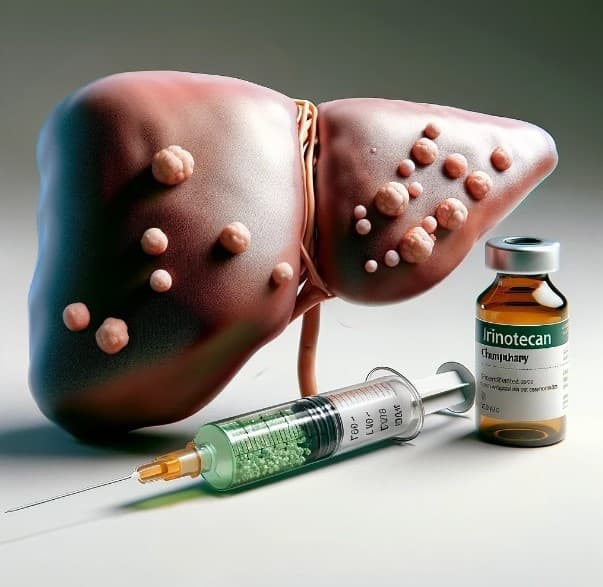
A Minimally Invasive Treatment Method for Liver Metastases Originating from Colorectal Cancer (CRC).
This treatment is indicated for metastases originating from colorectal cancer that involve both liver lobes.
It can be administered alongside standard systemic therapy to achieve a better response or when systemic therapy has failed. The method involves injecting particles that release the drug irinotecan directly into the hepatic arteries,
supplying blood to the cancerous metastases.
This method includes several catheterizations, ideally alternating catheterizations of the right and left liver lobes every two weeks, with a maximum of about 2-3 catheterizations per liver lobe.
Before deciding on the feasibility of the treatment, the patient undergoes a series of preliminary tests, such as CT, MRI, or PET-CT to assess the size, location, and number of metastases. The treatment is suitable for patients whose primary metastatic burden is in the liver and at least 40% of the liver is free of metastases.
On the day of the procedure, the patient receives pre medications to reduce the chances of pain and discomfort afterward, as well as antibiotics. An interventional radiologist inserts a catheter through the femoral artery in the groin or the radial artery in the forearm and guides it through the arterial system until the catheter reaches the hepatic artery. The procedure is performed under fluoroscopic imaging to ensure maximum accuracy.
Irinotecan-releasing particles are injected through the catheter directly into the hepatic arteries leading to the metastases. The particles deliver the drug locally, increasing its concentration within the tumor and reducing systemic side effects. Additionally, the particles block the blood supply to the tumor, leading to the destruction of cancer cells.
It should be noted that even among patients whose disease progressed after systemic treatment with irinotecan, the response rate to DEBIRI treatment was significant. A study published in the "World Journal of Surgical Oncology" included 55 patients who received 99 DEBIRI treatments, 54 of whom had previously received systemic chemotherapy, including irinotecan (FOLFIRI) and other drugs like FOLFOX and Avastin. The study results showed that DEBIRI provided better disease control and achieved higher response rates compared to previous systemic treatments, with an overall response rate of around 50-60% among patients treated with DEBIRI, compared to lower response rates after systemic treatments alone, which ranged around 10-18%.
Among the advantages are
-
Direct injecting allows for a higher concentration of the drug at the target site, increasing treatment efficacy
-
Reduction of systemic side effects due to direct injection instead of broad-spectrum treatment.
-
Preserves liver function and can make the patient eligible for curative treatments such as resection or ablation
-
Proven efficacy even for patients who failed previous chemotherapy.
-
Rapid recovery and return to routine within a few days.
-
Maximum precision under imaging to minimize damage to healthy tissue.
-
Minimally invasive procedure without the need for surgery or stitches.
Disadvantages and risks
-
Side effects include pain, fever, and nausea.
-
Rare complications such as infections or damage to healthy liver tissues.
-
Risk of tumor recurrence, which may require repeat treatments.
-
Necessity for a series of repeated catheterizations (every two weeks) to treat all liver lobes.
-
Risk of allergic reaction to the contrast material injected during the procedure.
-
Rare risk of blood vessel damage at the access site in the groin or hand.
More on interventional radiology
Back to all articles